

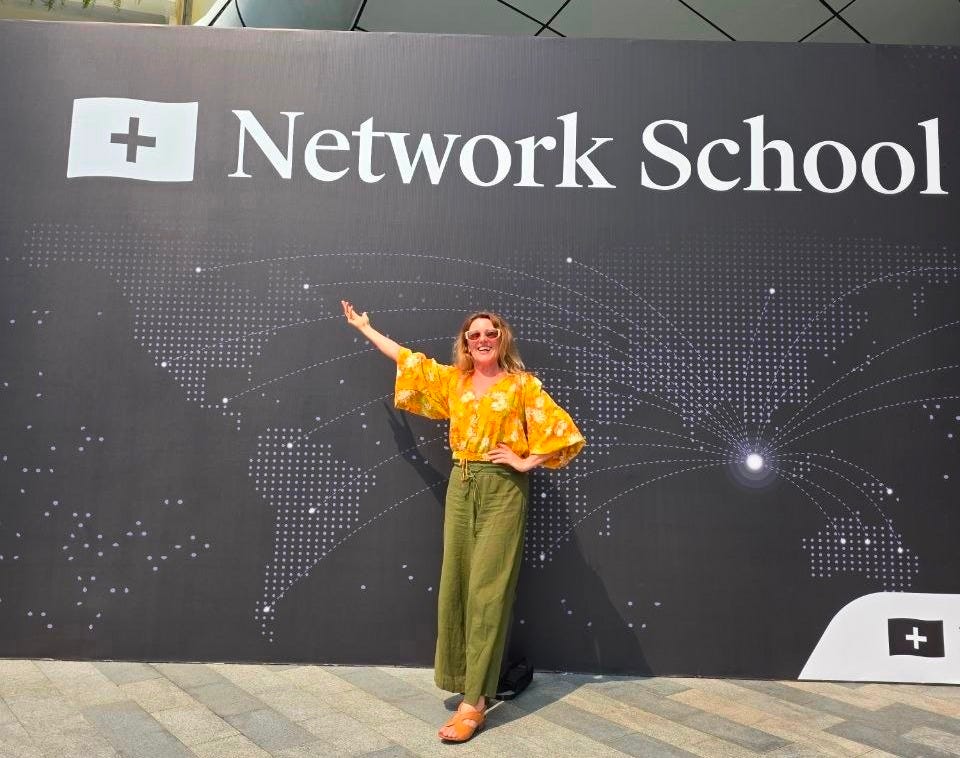
I’m at Network School - where startup societies start - and I keep seeing “code is law” in discussions about agentic economies, network societies and digital economic zones.
It is a serious claim, and it does not survive much scrutiny.
Code is execution. It performs an executive function.
The legislative function, deciding what the rules are, and the judicial function, interpreting those rules when facts are ambiguous or contested, are different tasks.
The separation of powers doctrine will be mirrored in a network-first economy because it has to be. Any system that exercises authority over people, assets or decisions ends up needing all three powers separated.
Societies separated these powers because concentrated power cannot be trusted
Montesquieu was writing from a civil law tradition, not a common law one, so this is not some Anglo legal habit that only makes sense to people from a few countries. Common law and civil law systems express it differently, but both recognise the same basic problem: the people who make the rules should not be the same people who execute them and then decide what they meant when something goes wrong.
People raised under either tradition - common or civil law - are used to some form of recourse. If network societies and agentic systems do not offer an equivalent, they will struggle to attract or retain anyone beyond a technical minority.
Early DAO governance already showed this
If you compress rule definition, execution and dispute resolution into code and token-holder voting without designing an independent arbitration function, there is no way inside the system to interpret what happened or resolve it. The 2016 DAO exploit showed this. The community had no governance mechanism to determine whether it was theft or legitimate use of the code as written.
The result was the Ethereum hard fork, itself an extrajudicial intervention, necessary because the design had compressed all three functions into code. The people who lost confidence left and the network split.
Some later blockchain projects introduced arbitration mechanisms. Proposals we are seeing now include dispute resolution and legal infrastructure for agents.
The point here is that when you design those functions, you are rebuilding separation of powers. So do you admit that and design it deliberately, or rediscover it after your society forks?
Agentic-economy thinking risks repeating this pattern
It compresses governance into execution and leaves rule-setting and interpretation either assumed, minimised or pushed outside the model. There is a lot of attention on registries, programmable payments, AI agents, new wrappers for legal personhood and jurisdictions designed around code-first coordination. Much of that work is useful in the network societies sandbox.
But the problem to solve is not new legal personhood for software. It is about proof-of-control:
How agent actions are tied back to human authority, intent and liability.
Who authorised the action, under what constraints, for whose benefit, against what rules, and who answers for it when things go wrong.
Machine execution is fast, scalable and opaque. That increases the need for accountability and review, not lessens it.
Our networks can replace corporations as organising forms
Our networks can replace corporations as organising forms, with agents cryptographically linked to personhood for legal authority, intent and liability. Then we do not need to create fake personhood through incorporation.
The problem to solve is how agent actions trace back to accountable humans, not whether software should be treated as a new category of legal person. But that accountability does not come from code alone. It requires human judgement, professional standards and trust.
Why I keep returning to history
At Network School, Balaji Srinivasan talks about re-decentralisation and encourages people to read historical texts while building new systems people would rather opt into. I agree with that instinct. Build the new thing rather than trying to reform the old broken model and the people clinging to it.
But you still need to understand what cannot simply be discarded. Why certain structures emerged, what problem they were solving, and what happens when you remove them without replacing the function they performed.
That applies to separation of powers. It also applies to qualified practitioners.
Professional people are trusted for reasons that go beyond state authority. They bring an instinct for standards, judgement, ethical duties, interpretive discipline and public standing developed over long periods of institutional life. That does not make the professions perfect. It does mean they offer value that protocol engineers often underestimate.
My concern is not that they are absent. It is that they are not visible at the level where the architecture is being formed.
Honestly, I may not be hearing every voice in these spaces, but my impression since becoming involved in the crypto and network societies movement is that qualified practitioners are mostly being engaged around compliance, structuring and government interface. That is useful, but it is a different purpose from helping shape the governance design itself.
Public accountants and tax advisers are trained inside these distinctions every day. We do not write the standards but we work within them - prepare, classify, evidence and report. When there is dispute, courts, tribunals and regulators interpret and apply the rules. That discipline teaches you where a function starts and stops, how authority is allocated, and what records will settle a dispute.
That is why protocol engineers need these professionals alongside them when they design governance systems. When AI starts designing those systems without us, we will not get a second chance to be included.
What we learned early in blockchain
You can disintermediate their roles, but if you want adoption, you still need to bring the disintermediated people into the design and adoption path, for trust to be transferred from human intermediaries into the new systems.
That was the motivation behind CREDU platform. When I designed it as the major project of my applied blockchain diploma, the principle was the same one I still argue for now with a network-first implementation of ‘decentralised professional association’: merge the members, not their professional bodies. If you give qualified people an incentive pathway to contribute their expertise and advocacy to the network directly, you gain network effects through their participation.
Network Effects 101.
Qualified practitioners belong at the frontier, not behind it
I want qualified accounting, legal, tax and governance specialists - and committees of their professional bodies - at the frontier of agentic network design, where new economies, societies and jurisdictions are being shaped, like Tools for the Commons.
Right now, as far as I can see, I am the only member of my profession advocating publicly for these disciplines to be part of the design conversation. That needs to change.
CREDU Academy is my attempt to start it (“every new movement starts with a school” - Balaji at Network School) whether or not our professional bodies support it. But I would rather they did, and I think it’s their interests to help us lead in this transition rather than follow it.
If every hard case ends outside the system, the system was never governance for the commons. It was just software and proprietary ambition, distanced from the open source ethos we claim to represent.
This is why I am opening CREDU Academy: a residency for accountants and technologists to collaborate on building these systems and the professional governance around them. I'm an original V1 member living at Network School, Malaysia/Singapore, where I work on international tax and professional collaboration solutions. If this interests and motivates you, I want to hear from you. electra@electrafrost.com
Thanks for reading - new get the word out!
These are intelligent thoughts Electra, but one suspects that they will ultimately set up an informative ‘crossroads’ with those who are attracted to network states for the essential rationale that they can establish (overtly or defacto) a form of techno totalitarian regime. Too often, those that rail against existing regulatory regimes simply want to replace them with their own perceived omnipotence. We shall see, however your quest is both noble and sound, in my(occasionally) humble view.
Hi Electra,
I have some thoughts on intentional communities, which are:
Communities function via a consensus. Consensus to participate, consent to abide or be governed, to contribute; to accept means of exchange and trade.
They also function within constraints - which locally means rules and globally means functioning within a wider set of rules and circumstances. A (digital) nation still functions in a political and economic landscape where it exerts some influence, accepts a measure of control as a condition of its continuing existence and obtains, by virtue of community consensus and within that consensus - a measure of freedom.
Free will is never absolute because we co-create realities together. Community does that more or less intentionally.
Rules, enforcement, process, algorithms - are answerable to creators (coders) who may understand code but can't reliably predict the circumstances that invoke that code.
I agree with you that clinging to the old is no substitute for embracing progress, and I also agree that creating progress is well informed by the past.
We fight a battle now, on every front - with the default patterns of human nature. To ego, to control, to certainty and to ideology. As a species, we always have. We do that against a backdrop of scarcity of resources between the arms of order and chaos - we always have. But there is always progress. so we go round in spirals, never back to the beginning.
The opposite of creation is inaction; just as the opposite of love is not hate but indifference.
Creation requires vision. Consensus creates rules, and coding literally enforces rules whether absolute or deterministically nuanced; but the system in which creation occurs always exists in the space of ideas.
Systems, societies, communities - are dynamic. The rules and precepts are tools of the visionary; not absolutes to be worshipped in their own right.
Cheers