

The Silk Road once crossed the land that is now Kazakhstan, linking China, Persia, India and markets further west. Now the country wants to become a regional hub for data centres, cloud computing and AI: a place where value moves digitally between the cloud and the land.

At Astana Finance Days 2026, a two-day conference I attended in Kazakhstan’s capital, the institutions and market participants around the Astana International Financial Centre (AIFC) shared how Kazakhstan wants law, capital, digital assets and AI infrastructure to fit together. The AIFC is an English-common-law jurisdiction with its own court, regulator and exchange, created to attract global capital, companies and talent and, most importantly to Kazakhstan, to serve as a laboratory for carefully reforming its own legal and regulatory systems.
For background, in his 2025 State of the Nation address, President Kassym-Jomart Tokayev set the country the target of becoming a “fully digital nation” within three years. That goal is now being pursued through the national “Digital Qazaqstan” strategy and a dedicated Ministry of AI and Digital Development.
As a Network School member and international tax professional, I came to learn more about redomiciling businesses under the AIFC regime and how that could support our community’s long-term objectives.
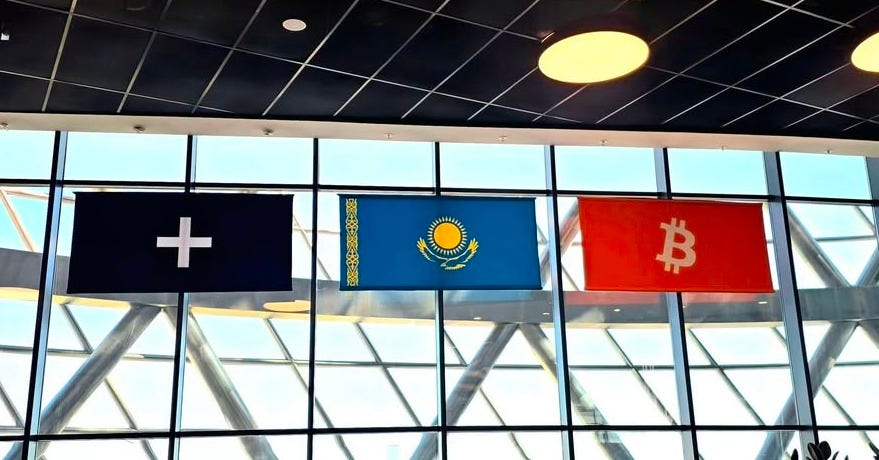
Founded by Balaji Srinivasan, author of The Network State, Network School is a startup society for remote workers, tech founders and creators, now in Astana, working with the Government of Kazakhstan under an MoU with the AI ministry and officially launched at Alem.ai in September 2026.
In the closed-door plenary, I heard Srinivasan make a great case for Kazakhstan attracting international technologists and professionals with particular literacies in Bitcoin, digital assets, blockchain systems, cryptographic verification, verifiable credentials and internet-native organisations. With AI, that expertise moves from the edge of the internet to the question of what a digital state can prove, and what people can trust.
"Kazakhstan is landlocked," Srinivasan told the plenary, "but it's not cloud-locked." He even offered the country a rebrand, "the land of the cloud".
He was making his classic pitch that the internet is a new continent, that “digital gold” sits in “a cloud bank account,” and that any country willing to move first can host the world’s assets. But here the pitch was targeted at Network School’s latest host nation: “Your market size isn’t 21 million anymore,” he said. “It’s 8 billion.”
Astana Finance Days presented the financial machinery of that ambition. Across two days the event described a state trying to build the airports before the planes arrive, and showed where the runway is still being laid.


A stable jurisdiction
The recurring word on stage was jurisdiction. Srinivasan framed the opportunity as a migration: as companies “re-domicile out of Delaware, New York, California,” he argued, they will seek “a stable jurisdiction,” and the Astana International Financial Centre (AIFC), with its English-common-law framework and its own court, wants to be on the shortlist.
The backing for that argument was heard from the “Corporate Law of the AIFC” panel, where practitioners explained why firms redomicile here: a corporate-law regime modelled on English common law, offering a familiar rulebook on governance, shareholder rights and officer obligations. Tatiana Tchedaeva, EVP for compliance and corporate governance at the miner Solidcore Resources, put it plainly - other common-law adapted zones had not offered the same familiarity to foreign companies’ boards and shareholders.
I gained real insight into the regime’s raison d'être from Aigoul Kenjebayeva, a partner at Dentons Kazakhstan. She firmly cast the AIFC as more than a booking centre for foreign money: it is a laboratory for improving Kazakhstan’s own legal and regulatory systems, to develop and test new digital-era approaches for the benefit of the country itself, not only its guests.
Reflect on how special economic zones and financial centres are normally sold as a way to import capital; now consider also how they be promoted to governments as a way to export reform inward. This extends to ambitious people and companies, with the AIFC’s Investment Tax Residency Programme courting globally mobile investors with new tax and digital-asset pathways.
Sergio Mello, Global Head of Stablecoin Solutions at Anchorage Digital, gave the thesis a fitting metaphor. A country positioning itself, he said, is engaged in “digital urban planning”: deciding what it will look like in “10, 20 or 50 years,” then deploying capital and regulatory goodwill so that today’s infrastructure “supports that growth without creating choke points.”
“This is the moment we build the airports and highways,” Mello said, “which makes it the most critical moment on the downside as well: the wrong ‘concrete mix’ can be catastrophic later.”
His unambiguous verdict on regulation: “Regulation can absolutely propel innovation.” Kazakhstan’s decade of progress, he argued, came “not from a lack of regulation but from proactive regulators.”
The National Bank made a distinctive move to propel financial innovation, the opposite of a crypto moonshot. Governor Timur Suleimenov explained that Kazakhstan has moved away from a retail digital tenge (”we’re not pursuing retail anymore; I don’t think it’s needed,” given how far the commercial banks’ payment apps have come) and repurposed its central bank digital currency as a public-finance tool.
“The best use for a CBDC in Kazakhstan is to programme and track public spending,” Suleimenov said: smart contracts that release digital tenge only when a project performs “exactly as envisaged,” whether “a kindergarten in a remote rural area or a huge petrochemical complex.”
Piloted from 2023 and since developed through public-finance use cases, this “public spending CBDC” is being rolled out with the Ministry of Finance. It is an unusual application that would structurally appear to be in the taxpaying public interest - less a bid to reinvent money than to make government money harder to waste.
Compute is the new concrete
In a talk titled “Capital in Compute,” Renat Tukanov, group CTO of Freedom Holding Corp. (Nasdaq: FRHC) and CEO of Freedom AI, argued that computing power has become an asset class, measured in a new unit, the GPU-hour, and financed like physical infrastructure, not expensed like equipment. Global investment in AI infrastructure, the deck projected, is heading toward roughly $700 billion, or about 16 GW of new data centres. For scale: New York City peaks at around 12.5 GW; Almaty draws about 2 GW and Astana about 1 GW. A single AI rack, he noted, can pull up to 130 kW, ten times a conventional server rack, and enough to force a shift to liquid cooling. A separate keynote in the programme presented the same idea, recasting the megawatt as “the new unit of account.”
Kazakhstan’s claim leverages two advantages: energy and location. The country plans some 13.3 GW of new generation capacity by 2029, at electricity prices well below Europe’s, and, as the deck noted, one large data centre can consume as much power as 100,000 households. The AIFC’s own AI as Infrastructure report shows an indicative long-term price of about $0.025 per kilowatt-hour for its planned Data Center Valley in Ekibastuz (scaling from 300 MW toward 1 GW), commercial data-centre utilisation of roughly 91% in 2025, and a domestic base of about 896 NVIDIA H200 GPUs across Alem.Cloud and AI-Farabium.
See Freedom’s “AI SuperCluster”: a $2 billion project with NVIDIA announced in November 2025, followed in July 2026 by a tripartite memorandum between the Ministry of AI, Citi and Freedom, with a first phase slated for Q1 2027. The announcements put the capital on a confident timeline.
But the same report is blunt about where the real bottleneck sits, and it isn’t silicon. It draws a hard line between technical and financeable capacity: a data centre or GPU cluster only becomes an asset once power, permits, operators and, above all, long-term contracted demand are locked in. The constraint is not compute supply but demand from customers that will pay for recurring high workloads. Kazakhstan’s risk is that it builds capacity faster than it builds the enterprise workloads to fill it, and that gap, more than any megawatt figure, is the investment question that kept coming up in the conference.
Tukanov was also candid about the ceiling. This is a hard race against other jurisdictions: the UAE has its 5 GW, $30 billion “Stargate”; Saudi Arabia expects AI to reach as much as 12% of GDP by 2030 on one PwC estimate. And the whole edifice is uncomfortable foreign dependency: high-end GPUs require US export licences. “Capital goes where risk is priced in” on a slide means that money flows toward projects where investors believe the risks have been identified, measured and adequately compensated. In compute, the main risk is stranded compute (underutilised capacity) after building a very expensive facility. That risk is not being priced in Astana; it is priced in Washington.
This is not just a supply-chain problem. It is a sovereignty problem: Kazakhstan may own the building and pay for the electricity, but still depend on decisions made by a foreign government and a few foreign technology companies. Kazakhstan may decide that it wants advanced NVIDIA systems, but the United States influences the export permissions. With export restrictions placed on certain advanced chips and AI systems to various jurisdictions, procurement delays can affect Kazakhstan’s access to advanced hardware.
Fake by AI, real by crypto
If compute is the infrastructure, Srinivasan used the plenary to argue why so much of value will end up recorded on it, and the argument began with a deflationary read on AI itself. Artificial intelligence is powerful, he said, but “ultimately downstream, because it’s self-prompted,” on a leash in a fundamental way.
Until a model can acquire its own data centres, power and robots and build all of that itself, it has “no drive to accumulate resources beyond what it’s prompted to do.” The near-term reality, on his telling, is mundane: one trader with an AI bot against another, “a trading arms race, not that different from today.”
A sharp warning about security: “Essentially every Web2 system will get hacked over the next few years,” he said, because AI makes attacks more sophisticated; the only systems that can hold trust will be on-chain, protected by “a 24/7, multi-billion-dollar bug bounty” on public networks like Bitcoin, Ethereum, Solana and Zcash.
“No single audit gives you as much confidence as a public blockchain,” he said, which is why, in his framing, the private keys for robots, drones and self-driving cars will end up managed on-chain as well. It is one more push toward his recurring thesis that, over time, every asset of real value becomes cryptographically represented. Then the line often discussed at Network School, which drew the room up short:
“AI makes everything fake; crypto makes it real again.”
Once anyone can generate a photorealistic passport, a picture of gold reserves or a deepfaked official, he posited, the only thing you can prove to the world is a cryptographic address you can post for verification. A diploma, a passport, a title deed: each will have to be represented on-chain to be trusted, something he said he “would hope to design with the AIFC.”
Sallianne Taylor, Head of Government Relations for EMEA at Bloomberg, responded: “it’s quite chilling, but I agree.”
Plumbing and trust
A hub is only as good as the rails beneath it, and Day 2’s panel on the AIFC’s digital-asset ecosystem avoided any evangelistic tones. Nurkhat Kushimov, general manager of Binance Kazakhstan, made the point that the regulatory framework was never the hard part. “Digital-asset companies don’t think of themselves as local,” he said; margins are thin, competition is fierce, and the business model has to be globally scalable.
The AIFC gave the industry a full suite of frameworks to operate within, but “banking relationships were the difficult part.” His firm could onboard customers in Kazakhstan, he said, but not always elsewhere. Getting from a licence to a working correspondent-banking relationship is the plumbing problem a would-be hub needs to solve for a digital-asset company.
A counterpart on the same panel, Konstantin Kraus of Kraken crypto exchange, supplied the flip side, and one of the conference’s strongest outside endorsements. He argued that serious, heavily-regulated institutions are drawn toward credible jurisdictions that are not light touch: Kazakhstan’s real selling point is regulatory openness paired with institutional credibility, with regulators and industry treating rule-making as a two-way exchange rather than a diktat. Institutional firms don’t shop for the easiest regime; they shop for the one that is predictable and commercially workable.
Mello’s stablecoin use cases spoke to how far the technology has already moved into the mainstream. Since the US GENIUS Act was signed and Europe began reviewing MiCA after its initial implementation, he argued, stablecoins are “no longer an experiment”; accounting and securities regulators are beginning to treat them as a settlement asset. The demand is institutional and unglamorous: corporate treasury moving liquidity across time zones over a weekend; “stablecoin correspondent banking” that lets banks keep trusting each other across an ocean while settling 24/7; and collateral mobility. As proof of concept, he said, Anchorage “intentionally onshored $2 billion of collateral capital on a bank holiday” to demonstrate how a tokenised asset changes execution speed.
A panel on financial intelligence (bringing together the AFSA board, Kazakhstan’s Eurasian Bank, the Egmont Group of financial-intelligence units and the analytics firm Sherlocq) put the compliance case in one line: technology will not replace the compliance officer, but it can give the speed to prevent crime rather than merely react to it.
Bolstering confidence in the legal side is the AIFC Court, an independent common-law civil-and-commercial court, the subject of its own session on protecting investor rights, whose whole purpose is to give foreign investors a familiar, neutral forum for dispute resolution.
The least glamorous part of their redomicile marketing may be the most important: capital does not want to move to a place it cannot sue in.
Does the cluster exist yet?
Drawing on the UC Berkeley scholar Jerome Engel, Zubr Capital’s Oleg Khusaenov argued that innovation clusters “are not about geography but about a system of interaction,” the dense overlap of funds, corporates, universities, professionals and government that a single innovation company cannot assemble for itself by itself. His finding on innovation “begins not with an idea but with a business,” and a cluster’s value is that it combines what is otherwise hard to combine. The innovation cluster test was interesting to assess Astana against.
By that test, some ingredients are visibly present. Capital is landing in physical form: a BI Group presentation on commercial real estate walked through an active project pipeline in the hundreds of millions of dollars (the BION mixed-use precinct chief among them) in an Astana of some 1.7 million people, with the National Bank’s base rate at 16.25% and inflation slowing for an eleventh consecutive month.
New asset classes are being tested, too: a Day 2 session featured the creative industries, music in particular, as an emerging, tokenisable asset class, with founders seeing that a song is “a full-fledged financial asset” that banks and investors still refuse to fund.
Harder assets are being put to the test too: one session walked through tokenising Kazakh agricultural commodities on Solana (the worked example a farmer raising $200,000 from many small investors against grain-receipt tokens), while another supplied the sober caveat: minting a representative token is trivial, but manufacturing a legally enforceable claim on the token’s underlying real world asset (RWA) is not.
Who owns the RWA, what happens in insolvency, who controls the smart contract, what can a holder enforce in court? Those, not the code, are the factors influencing whether investment comes to the table. The same “real asset, missing financial layer” issue surfaces in mining, where the EBRD cast junior miners’ difficulty as one of investor-readiness (data, governance, transparent ownership) and put €150 million behind moving them from discoveries toward bankable projects.
Other ingredients are conspicuously thin, and despite the busy Binance stand, this digital asset themed session revealed it. When Kraken’s EMEA institutional lead, Konstantin Kraus, asked a room full of professionals how many had used or held crypto, “less than a handful” put their hands up.
The officials acknowledged the same gap in their own way. Asked what one thing they would change in three years, Governor Suleimenov wanted “a less bank-centred financial system,” with securities markets playing a far larger role; the AIFC’s governor, Renat Bekturov, named the hardest problem of all, “the depth of liquidity in our financial system,” something a regulator can influence but not control.
What to watch
I came away from Astana Finance Days 2026 having heard a very clear statement of intent. The vision is expansive, and Srinivasan sees the “land of the cloud,” a country that puts “every valuable asset, document and credential on-chain.” The execution is more modest and more interesting: a programmable CBDC aimed at public spending, a $2 billion compute cluster with a delivery date, a common-law court, and a regulator, in Bekturov’s words, trying to stay “a little ahead” without getting so far in front that the market suffers.
Three things to watch in this hub:
First, compute: does Phase 1 of the Freedom AI SuperCluster land on schedule in early 2027, and can Kazakhstan secure the high-end GPUs that only a US licence unlocks?
Second, redomiciliation: does the AIFC’s common-law promise (and the more ambitious “laboratory” version of it) actually pull companies out of Delaware and its rivals, or remain a talking point?
Third, liquidity and adoption: the problems the officials themselves flagged as hardest.
A remote country cannot change its geographic coordinates. Whether it can change its market size from 21 million to something nearer 8 billion is the wager Astana is placing. The concrete is being poured, and, as Anchorage’s Mello warned, the danger runs both ways: the wrong mix “can be catastrophic later,” but hesitation has its own price, since with the world moving this fast, he said, “any inaction now is equivalent to a decade of inaction last century.”
Can Astana get the mix right, and can it set in time for the planes to land?
It is a wager I am close enough to want to see through, and one we intend to help make happen.
A note on sources: this piece is drawn from my own notes taken live during the sessions, which may not perfectly reflect each speaker’s words, both because of my own inferences and because I was often listening through the conference’s translation headsets. Where a colleague’s shared notes covered ground relevant to mine, I’ve folded in the details that were useful, to give readers a fuller account.